 Aurora Borealis Tour Rovaniemi
Rovaniemi Northern Lights Forecast: How to Read It Without Fooling Yourself
Every Rovaniemi northern lights forecast you can open on your phone answers a question you did not ask. The apps report geomagnetic activity across the whole planet, averaged over three hours, while the thing that decides your evening is whether there is a hole in the cloud within driving distance of this town. Both matter. Only one of them gets an app icon. Below we go through the sources local guides actually open before they decide which direction to drive, what the KP number means at 66 degrees north, and what happens to your money when the sky is hopeless.
Three Forecasts Decide Your Night, Not One
Geomagnetic activity, solar wind, cloud cover
The first tells you whether the aurora will be strong. The second tells you when, within about half an hour. The third tells you whether you will see any of it, and it is the one that cancels tours.
Guides here work the list backwards. They check the cloud maps first, because a KP 6 storm behind a solid deck of stratus is worth exactly nothing, while a modest KP 2 over a clear sky at this latitude will fill your camera. Then they look at the solar wind readings from the satellites parked between the Earth and the sun, which give roughly 30 to 60 minutes of warning that something is arriving. The KP forecast comes last, as background.
Most visitors do the opposite. They download an aurora app, watch a red bar appear at three in the afternoon, and book nothing until it does. That is how people end up standing under cloud on the one clear-KP night of their trip.
What each source is good for
None of these is a prediction of what you will see from your hotel window. Each answers one narrow question, and the skill is knowing which question you are asking.
| Source | What it tells you | How far ahead | Worth opening? |
|---|---|---|---|
| Northern Lights Alert (nlalert.fi) | Local aurora alerts for Lapland with named towns including Rovaniemi, Levi and Ivalo | Now, plus short-term alerts | Yes, the closest thing to a local answer |
| Finnish Meteorological Institute, auroras and space weather | Official magnetic disturbance measured in Finland, plus the national cloud and weather forecast | Now and several days | Yes, and it is the same institute the tour desks quote |
| Sodankylä Geophysical Observatory magnetometer | Live magnetic field trace from 130 km north of Rovaniemi | Live, minutes | Yes if you like raw data over dials |
| NOAA space weather (KP, solar wind) | Global geomagnetic index and solar wind speed and field direction | 30 to 60 minutes, plus 3-day outlook | Yes for timing, no for whether to book |
| Consumer aurora apps | A KP number and a probability, usually global | 3 days and 27 days | As a nudge, never as a decision |
| Any 27-day aurora forecast | Where the sun's active regions will point next rotation | 27 days | No. It cannot know your cloud cover |
What KP Actually Means at 66 Degrees North
The number was not written for Lapland
KP runs from 0 to 9 and describes how disturbed the Earth's magnetic field is globally, averaged over a three-hour block. A rising KP pushes the auroral oval further south, which is why a KP 7 makes headlines in Germany and Scotland.
Rovaniemi already sits under the oval. On an ordinary quiet night, KP 2 puts a visible arc across the northern sky here, and KP 3 lifts it overhead. What a high KP buys you at this latitude is not presence but drama: faster movement, more pink and violet at the lower edge, coverage across the whole sky rather than a band on the horizon.
That three-hour averaging also hides the thing you care about. A ten-minute substorm that fills the sky can sit inside a three-hour block reported as KP 3. Guests come home saying the app was wrong when the app simply was not measuring the same thing they were watching.
The number that actually predicts the next hour
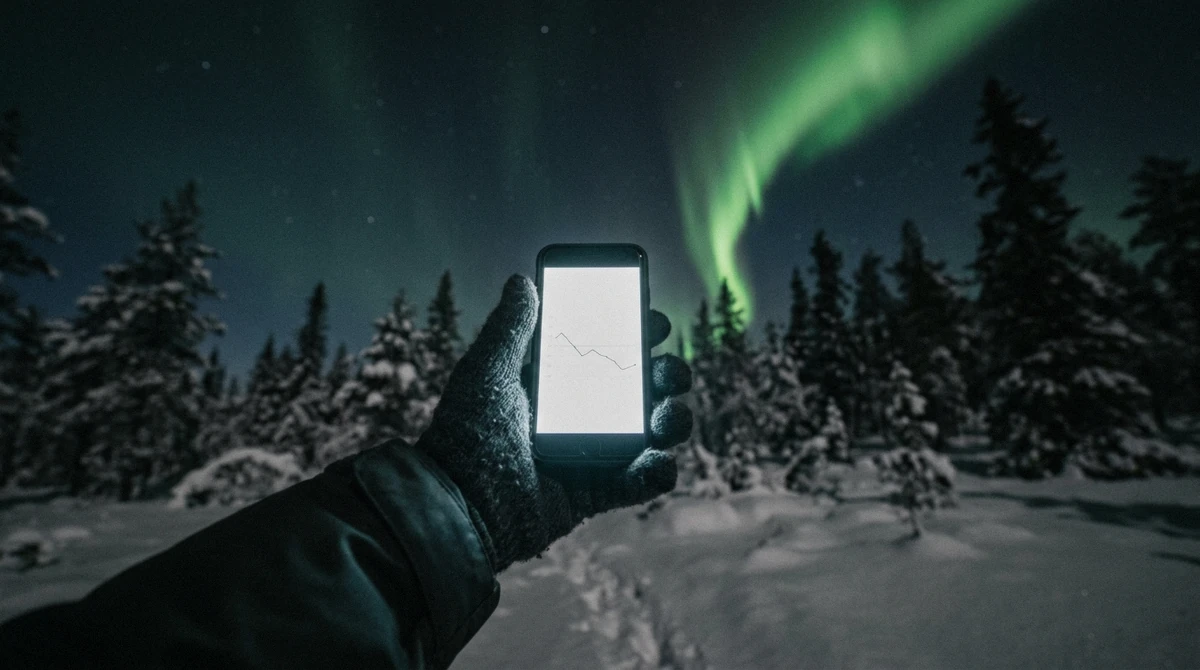
If you want a single reading that tracks what is about to happen, it is not KP. It is the direction of the interplanetary magnetic field, the value written as Bz. When Bz turns negative, the solar wind couples to the Earth's field and the aurora responds within the hour. A strong solar wind with Bz sitting positive can pass over Lapland and produce almost nothing.
Guides watch Bz and solar wind speed on the satellite feeds while they drive. That is the source of the moment several guests describe in their reviews, where the driver announces the lights are coming and they arrive a few minutes later. It is not intuition, it is a graph.
What to Do With Tonight's Numbers
If the cloud map shows a clear patch within about 200 km and KP is 2 or above
go out. This is a normal good night in Rovaniemi, and it is the night most of the strong photographs on operator pages were taken on.
If KP is 5 or 6 but Lapland is covered edge to edge
expect the tour to run anyway on unlimited-mileage tickets, and expect a long drive west. Guests on those nights describe three-hour transfers toward the Swedish border and returns after four in the morning.
If the whole of northern Finland, Sweden and Norway is under one front
expect the operator to cancel and move you. Take the reschedule rather than the refund if you still have nights left in town.
If your app shows a red alert three days out
ignore it as a booking signal. Book early in your stay regardless, because the reschedule is the part of the guarantee that has real value.
If you have one night in Rovaniemi and it looks marginal
go. A faint arc photographed properly still beats nothing, and every listed tour has free cancellation up to 24 hours ahead, so holding the seat costs you nothing until then.
What Cancels a Tour, and What You Get Back
Weather cancels, aurora strength does not
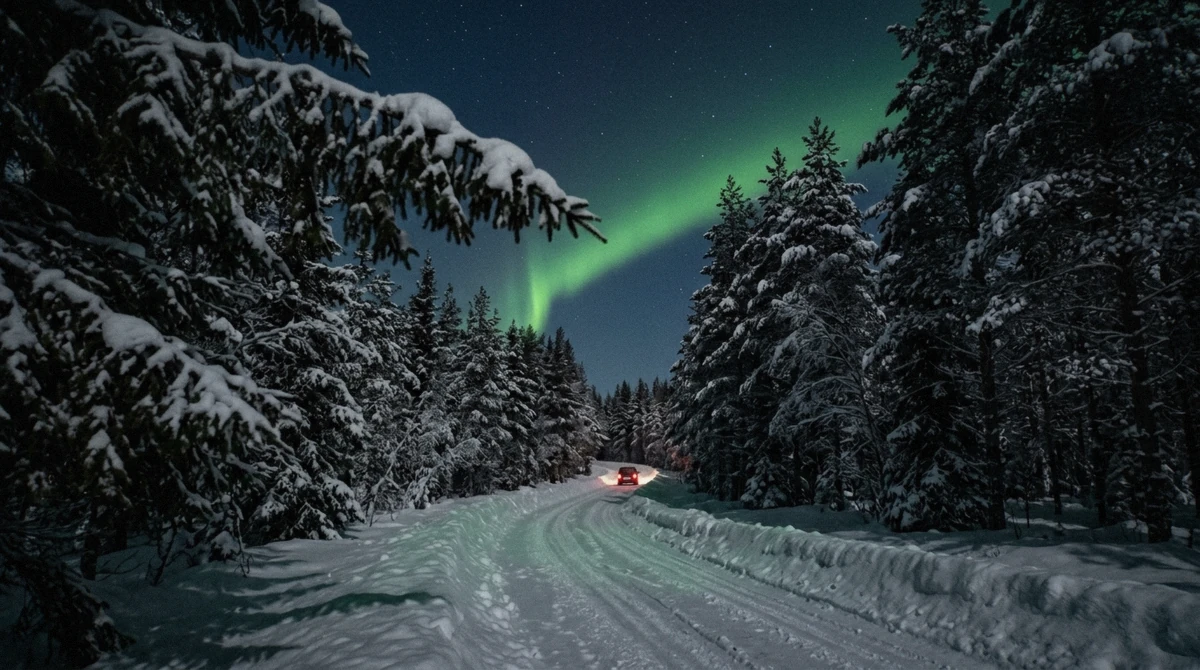
No operator in this town cancels because the aurora forecast is quiet. They cancel when the cloud forecast leaves nothing within reach, or when the roads are unsafe. Those are different problems with different odds, and mixing them up is the source of most of the frustration in the reviews.
When an operator does call it off, the sequence is the same across the four tours we track: your booking moves to the next night, and the night after that if it has to. If no workable night is left before you leave Lapland, they refund you. One guest describes exactly that outcome, a full refund after two days of monitoring, and rates it five stars for the honesty. Another describes two cancellations in a row and a ruined plan, which is the same policy seen from the other end of a short trip.
The fine print underneath all of it is worth reading once. Book Lapland's own listing states that aurora visibility cannot be guaranteed and is not a basis for refunds. We go through what the guarantee does and does not cover on the guided aurora hunts from Rovaniemi page.
Free cancellation is the other half of the plan
Every tour we list allows free cancellation up to 24 hours before departure. That single term changes how you should use the forecast.
Book your seat for the first evening of your stay, before you know anything about the weather. If two days out the picture is hopeless, cancel and rebook for later in the week at no cost. If it looks marginal, keep it, because marginal nights in Lapland are frequently better than they forecast and the guide has a whole region to work with.
What does not work is waiting for certainty. The good nights sell out, and in December and January the small-group vans go first.
How Far Ahead Any of This Is Worth Reading
Three days, three hours, thirty minutes
A three-day space weather outlook is a genuine forecast, built on which active regions are facing the Earth and what has already left the sun. Treat it as a weather forecast of similar confidence: useful, not binding.
A three-hour KP block is a measurement window, not a promise about any given minute inside it.
A solar wind reading from the satellites is the only short-range certainty you get, and it buys 30 to 60 minutes.
The 27-day outlooks people share on forums are based on the sun rotating the same active region back into view. They tell you nothing about whether Rovaniemi will be under cloud four weeks from now, which is the only variable you can still act on.
| Timescale | What it can tell you | What it cannot |
|---|---|---|
| 27 days ahead | Which solar active regions rotate back toward Earth | Anything about cloud over Lapland, which is the deciding variable |
| 3 days ahead | A genuine space weather outlook, plus a usable cloud forecast | Exactly which hour the sky opens |
| 3 hours | The averaged KP block you see in most apps | A ten-minute substorm hidden inside the average |
| 30 to 60 minutes | Solar wind speed and field direction from the satellites | Whether your particular valley is clear |
| Right now | Live magnetometer traces and local alerts | Nothing beyond the next hour |
Where the solar cycle sits right now
Solar Cycle 25 peaked in October 2024. The winters of 2026 and 2027 fall on the declining side of that curve, and NOAA's forecasters put current activity well above the long-term average. The years after a maximum are known for fast solar wind streams from coronal holes, which produce recurring displays rather than single headline storms.
In practice that means a Rovaniemi week in this part of the cycle carries decent odds on any clear night, without needing a storm to be forecast at all. The equinox months help further, and we set out the month-by-month picture in the best time to see the aurora here.
None of it survives contact with a stationary low over Lapland. That is why the answer to "should I book" is never a number from an app. If you would rather try it from a fixed spot in town, we set out the realistic version of that in seeing the aurora without a tour, including what the lights over Santa Claus Village really look like.
Why the Sky Rarely Matches the Photograph
Your eyes and the sensor are not reading the same sky
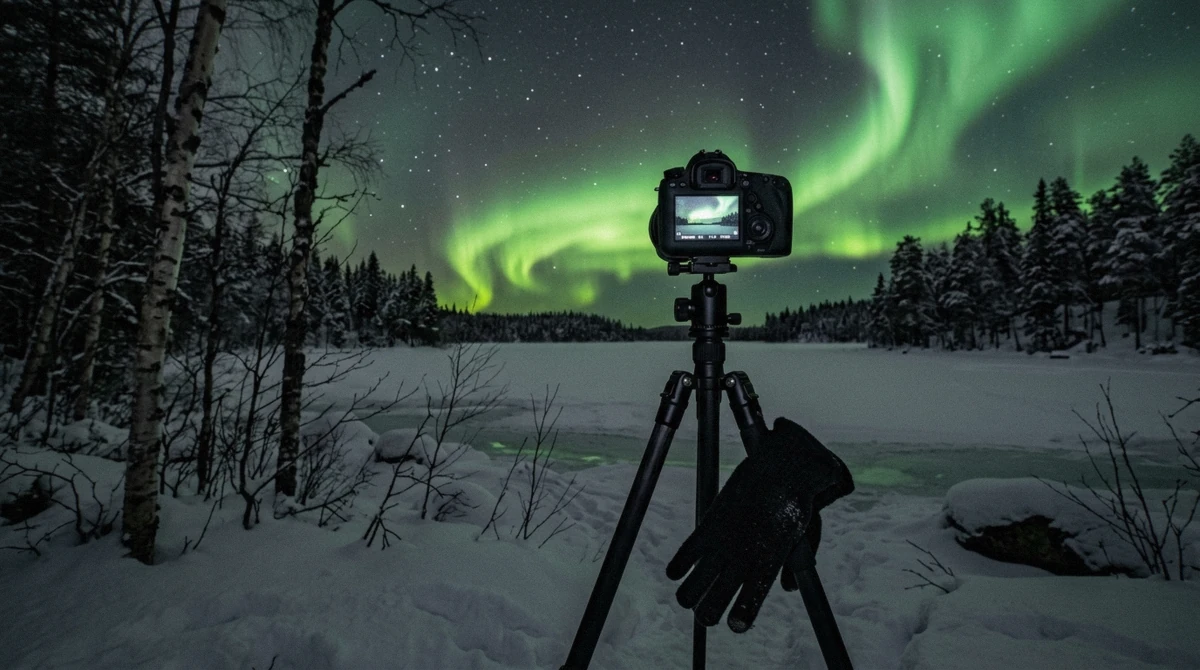
In darkness your vision switches to rod cells, which register shape and movement but very little colour. A camera on a ten-second exposure collects everything your eye throws away. The result is that a genuine, forecast-matching aurora can look like a pale grey ribbon overhead and vivid green on the back of the camera.
This is the single most common cause of disappointment, and operators have started saying so in their own listings, because heavily edited and AI-generated aurora images have pushed expectations past anything the real sky produces. One guest put it plainly after a strong night: the lights were spectacular, and they were not as green as the pictures.
On a strong display, with movement and structure, everyone sees colour. Those nights need no explaining.
What a good forecast night looks like from the ground
Aurora probability across the night peaks around 23:30, so the shape below is what the hours either side of that usually look like. You arrive at a dark spot and see nothing for twenty minutes. A pale band appears low in the north, easy to mistake for cloud lit by a distant town. Someone takes a test shot and it comes back green, which is how you know it has started.
Over the next hour the band brightens, lifts, and at some point breaks into vertical structure that moves faster than you expect. That phase might last ten minutes or an hour. Then it fades back to a smear, and the group either waits or drives on.
A guide reading the graphs will often tell you to wait, because substorms come in sequences. That patience is most of what you are paying for on an unlimited-mileage ticket.
Frequently Asked Questions
Can you see the northern lights in Rovaniemi tonight?
Check two things: a live aurora alert service for Lapland, and the cloud forecast for northern Finland. If the sky is clear and the season is between late August and early April, the odds on any given night here are decent, and no separate aurora storm is needed. If it is overcast, no forecast number helps you from a fixed spot in town.
What KP number do you need in Rovaniemi?
Lower than most visitors assume. KP 2 usually puts a visible arc in the northern sky at this latitude, and KP 3 lifts it overhead. Higher numbers add movement, colour and coverage rather than deciding whether anything appears at all. The KP scale was designed to describe global disturbance, so its headline values are written for places much further south.
Which aurora forecast is most reliable for Lapland?
For local alerts, a Lapland-specific service that names towns rather than continents. For measured data, the Finnish Meteorological Institute and the Sodankylä observatory's magnetometer, 130 km north of Rovaniemi, which has recorded the geomagnetic field since January 1914. For timing within the hour, the solar wind readings. No single one of them replaces the cloud map.
Why did my tour get cancelled when the aurora forecast was high?
Because operators cancel for cloud and road conditions, not for weak aurora. A strong geomagnetic forecast behind an unbroken deck of cloud across northern Finland, Sweden and Norway gives a guide nowhere to drive. When that happens the standard response across the tours we track is to move you to the next night, then refund if no workable night remains.
How many nights should I plan for in Rovaniemi?
Three to four. That is enough for the rescheduling to have somewhere to go, and it is roughly what tour companies covering the whole of Finland recommend. Book the tour for your first evening and hold the rest of the week in reserve, since a guarantee that moves your booking is worthless on the night before your flight home.
Does the moon ruin the northern lights?
No, though it changes the photographs. A full moon lifts the ambient light and washes out the faintest arcs, while also lighting the snow, which many photographers prefer. Cloud is the variable that decides your night. Moon phase is a detail you can plan around if you are chasing a specific kind of image.
Is it worth booking a tour if the forecast looks quiet?
Usually yes, when the sky is clear. A guide with unlimited mileage can reach a clear horizon you cannot see from town, and a quiet-forecast night with an open sky beats a storm behind cloud. Every tour we list carries free cancellation up to 24 hours ahead, so a seat held early costs nothing if the picture changes.